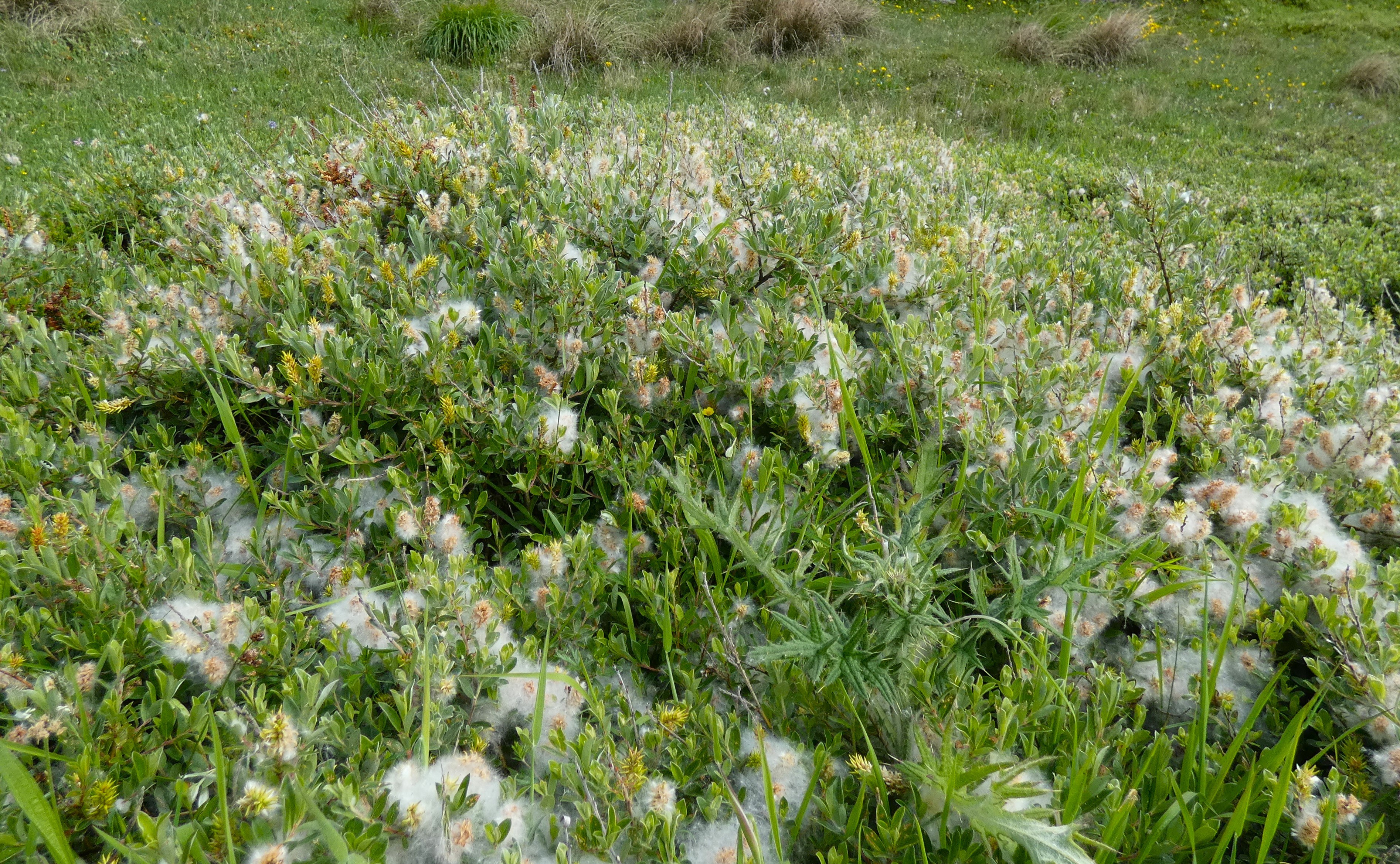
Latin name: Salix repens
Creeping willow (Salix repens) is a low-growing shrub found across a range of open habitats in the Yorkshire Dales National Park.
This highly adaptable species forms part of the Dales’ upland landscapes, particularly in heathland, moorland and wet grassland. It varies in appearance depending on local conditions such as soil type, moisture levels and exposure, making it a characteristic plant of the National Park’s diverse environments.
Identifying creeping willow
Creeping willow typically grows as a low, trailing shrub, spreading across the ground in open habitats.
Key features include:
- Straggling, creeping branches
- Short, oval leaves with silky silver undersides
- Red-brown twigs
- Catkins (flower clusters) appearing in spring, usually 2–2.5cm long
In wetter habitats such as fens, plants may develop a more upright growth form.
Seasonal importance
Creeping willow flowers in spring, producing catkins that are an important early source of nectar and pollen.
These flowers support bees and other pollinating insects emerging after winter, and the wider food web within upland ecosystems. This makes creeping willow an important part of the Yorkshire Dales’ biodiversity.
Habitat in the Yorkshire Dales
Creeping willow occurs across a wide altitudinal range, from lowland areas to uplands.
In the Yorkshire Dales National Park, it is most often found in:
- Heathland and moorland
- Wet grasslands and fens
- Nutrient-poor peaty soils
The National Park supports some of the key upland populations in the British Isles, reflecting the importance of these habitats for the species.
Distribution and population trends
Creeping willow is found across the UK but has experienced significant declines in parts of southern England.
More recently, new populations have been recorded in north-west England, southern Scotland and central Ireland, helping to offset losses elsewhere. The species remains more widespread in northern upland areas, including the Yorkshire Dales.
Despite this, its overall status reflects ongoing pressures on its habitats.
Threats and conservation challenges
Creeping willow faces several threats affecting its survival:
- Ring dying, caused by the fungus Rosellinia desmazieresii
- Inappropriate grazing regimes, which can damage plants or prevent regeneration
- Changes to wetland and peatland habitats
These pressures highlight the importance of careful land management in upland areas.
Conservation status
Creeping willow is currently classified as Near Threatened on the Vascular Plant Red Data List for Great Britain (2025).
Within the Yorkshire Dales National Park, it is designated as a Category 1 Priority Species in the Yorkshire Dales Nature Recovery Plan.
This status reflects its importance in upland habitats and the need for targeted conservation and monitoring.
Monitoring and management
Ongoing conservation work in the Yorkshire Dales focuses on:
- Monitoring population health and distribution
- Assessing regeneration and long-term viability
- Guiding grazing management and habitat protection
- Identifying opportunities for habitat restoration and expansion
This evidence-led approach supports long-term planning and helps maintain the species within the National Park.
Why creeping willow matters
Creeping willow is an important indicator of the health of upland peatland and wet grassland habitats in the Yorkshire Dales.
Its presence reflects well-managed moorland and fen ecosystems, healthy soil and hydrology conditions, and a functioning upland biodiversity network. Protecting this species supports the wider nature recovery goals of the Yorkshire Dales National Park.
Nature Recovery Plan
Find out how partners are working together to create a richer, more connected landscape for nature and wildlife.
Read more about Nature Recovery Plan