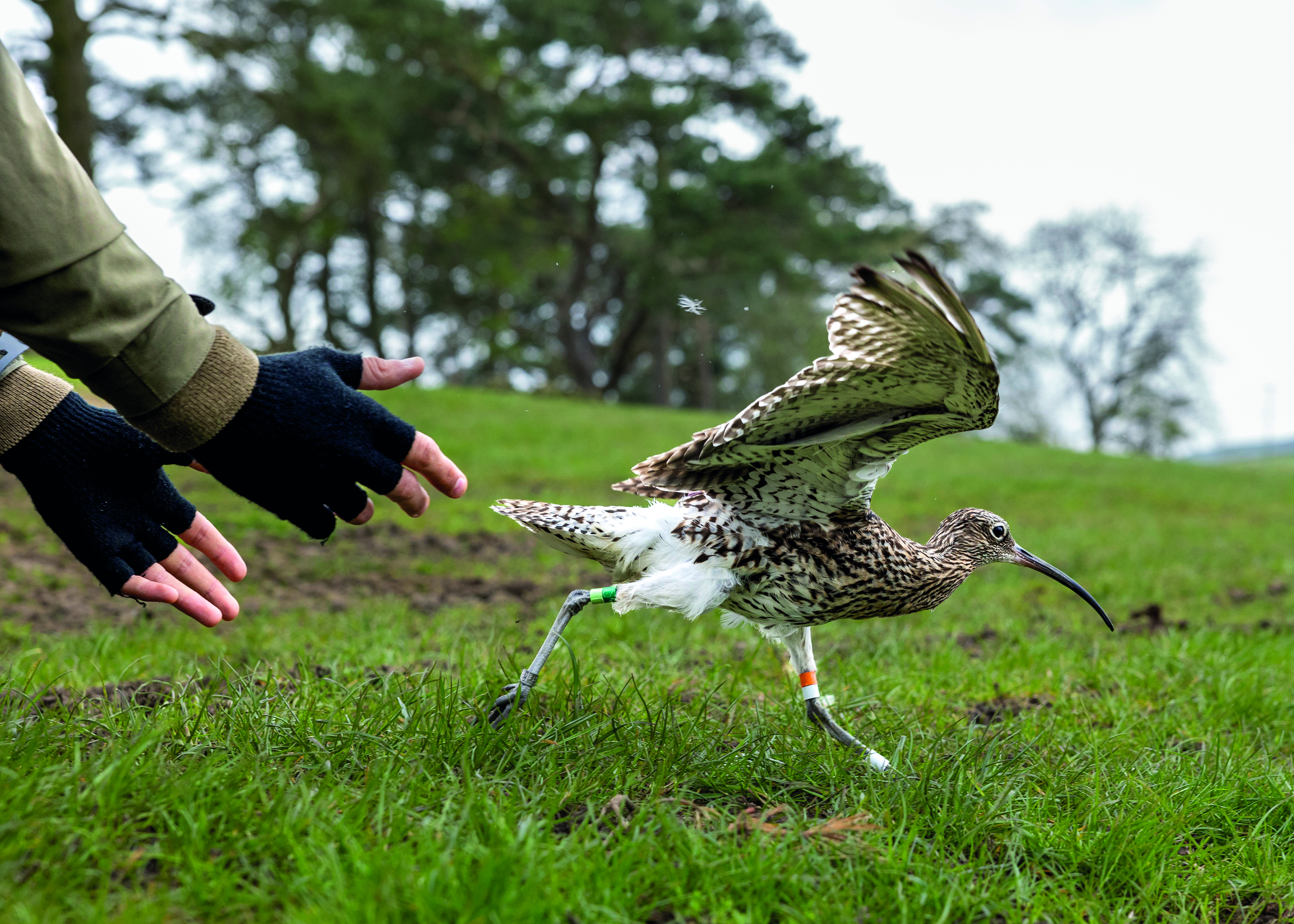
About the project
The meadows, moorland and moorland fringe habitats within the Yorkshire Dales National Park are home to nationally important numbers of breeding wader species. A number of these species are undergoing significant population declines in both the UK and elsewhere in Europe. The curlew (Numenius arquata) is one of these species under threat and is now listed as globally near-threatened. As the UK holds roughly a third of the European breeding population, upland areas such as the Yorkshire Dales are becoming increasingly important for this enigmatic species. The Yorkshire Dales National Park Authority (YDNPA) is working with several key stakeholders to develop initiatives that will help to protect breeding waders in the National Park and elsewhere in the Northern Upland Chain Local Nature Partnership area.
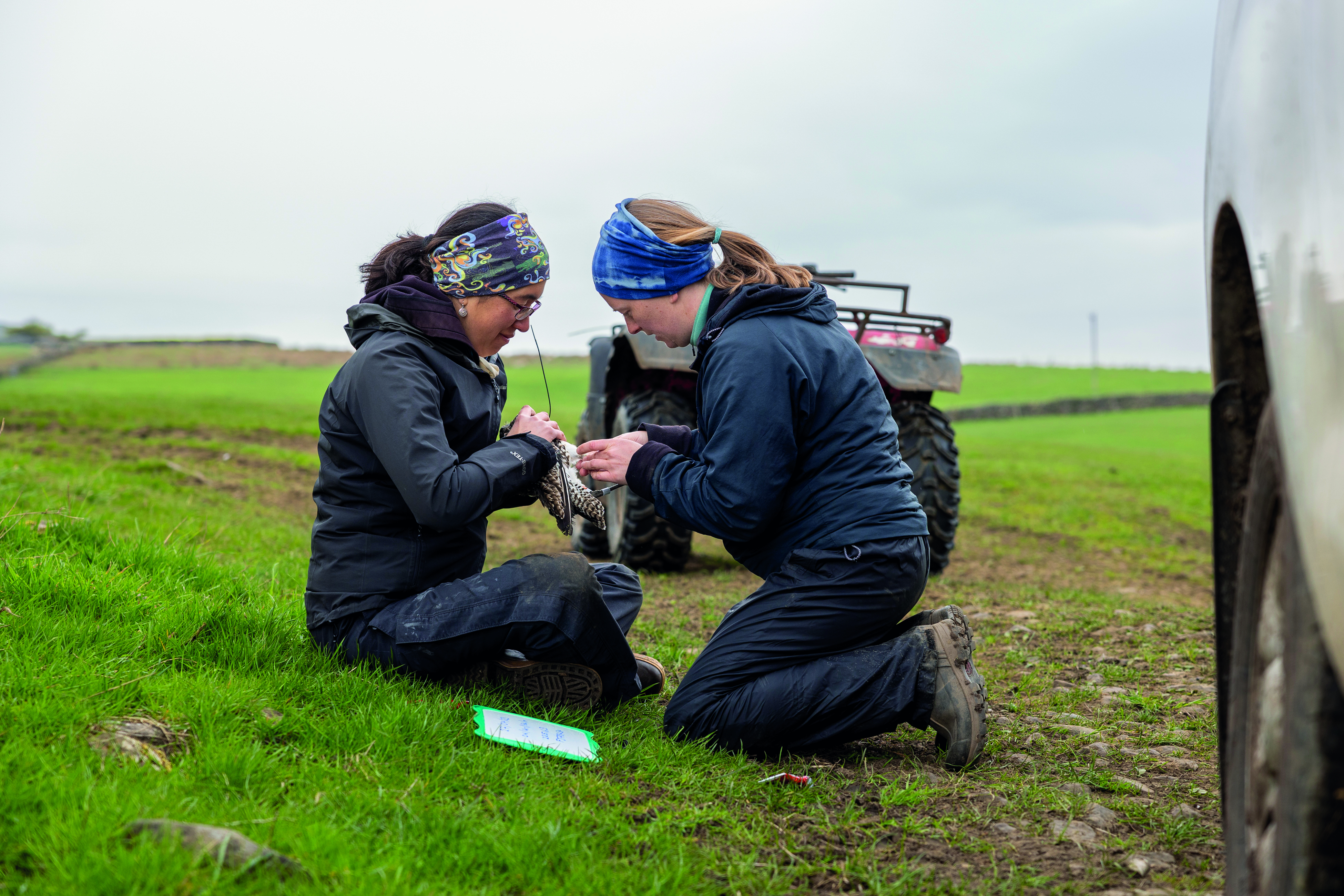
BTO tagging a curlew
In the summer of 2017, an innovative pilot project which trialled methods for involving gamekeepers and farmers in monitoring breeding waders was undertaken in Wensleydale. The British Trust for Ornithology (BTO), the YDNPA and Bolton Castle Estate staff worked together on the project which involved wader nests being monitored with temperature data loggers and trail cameras to monitor nesting success. Gamekeepers and farmers also carried out wader surveys using methods designed to fit around their work schedules.
The YDNPA has also been working with BTO to undertake a review of existing data and to assess different monitoring options for assessing the status of breeding wader populations in the Yorkshire Dales National Park.
Reports and further information
- Monitoring Breeding Waders in Wensleydale trialling surveys carried out by farmers and gamekeepers (PDF, 2.0 MB) (opens in new tab)
- Review of data and monitoring options for assessing the status of breeding wader populations in the Yorkshire Dales National Park (PDF, 2.0 MB) (opens in new tab)
- Farming in Protected Landscapes
- Curlews
Why do Curlew need our help?
The UK and the Yorkshire Dales are important for Curlew. The Curlew is a species of global conservation concern, and the UK is thought to be home to roughly a third of the European breeding population, with a similar proportion spending the non-breeding season in the UK. Most wintering Curlew is distributed along the UK’s extensive coastline, but the Yorkshire Dales is one of a small number of inland breeding areas that also support Curlew through the autumn and winter. Farm and moorland management practices in the Yorkshire Dales, including predator control and relatively low-intensity farming, have allowed breeding Curlew to maintain higher breeding success here than in most other English landscapes.
The BTO Wader Project Officer, Paul Noyes says “It is clear from speaking to folk who are on the ground day-in-day-out, whether these are farmers, gamekeepers, locals, or ‘incomers’, the vast majority regard ‘their Curlew’ as an essential part of the landscape they love and protect. Many things these people do for Curlew, like looking out for nests and chicks when it comes to cutting grass, seem extraordinary to outsiders but are done almost unconsciously, as part of an unspoken duty of care. However, it’s essential we don’t take what has been working for waders in the Yorkshire Dales for granted: it is threatened by change”.
Curlew populations have declined nationally. National monitoring schemes and studies have highlighted drastic declines in the UK’s breeding Curlew population, with the Breeding Bird Survey (BBS) estimating an overall -48% decrease from 1995-2020 (as per the graph below). Surveys of lowland wet grassland populations recorded a similarly large -39% decrease 1982-2002, and 50% of 12 upland study areas across Britain (including North Yorkshire) showed significant breeding Curlew population declines between 1980-2002, with only one area (South Pennines) experiencing a significant increase. You can explore other changes in UK Curlew populations yourself, using the BTO’s Trends Explorer webpage.
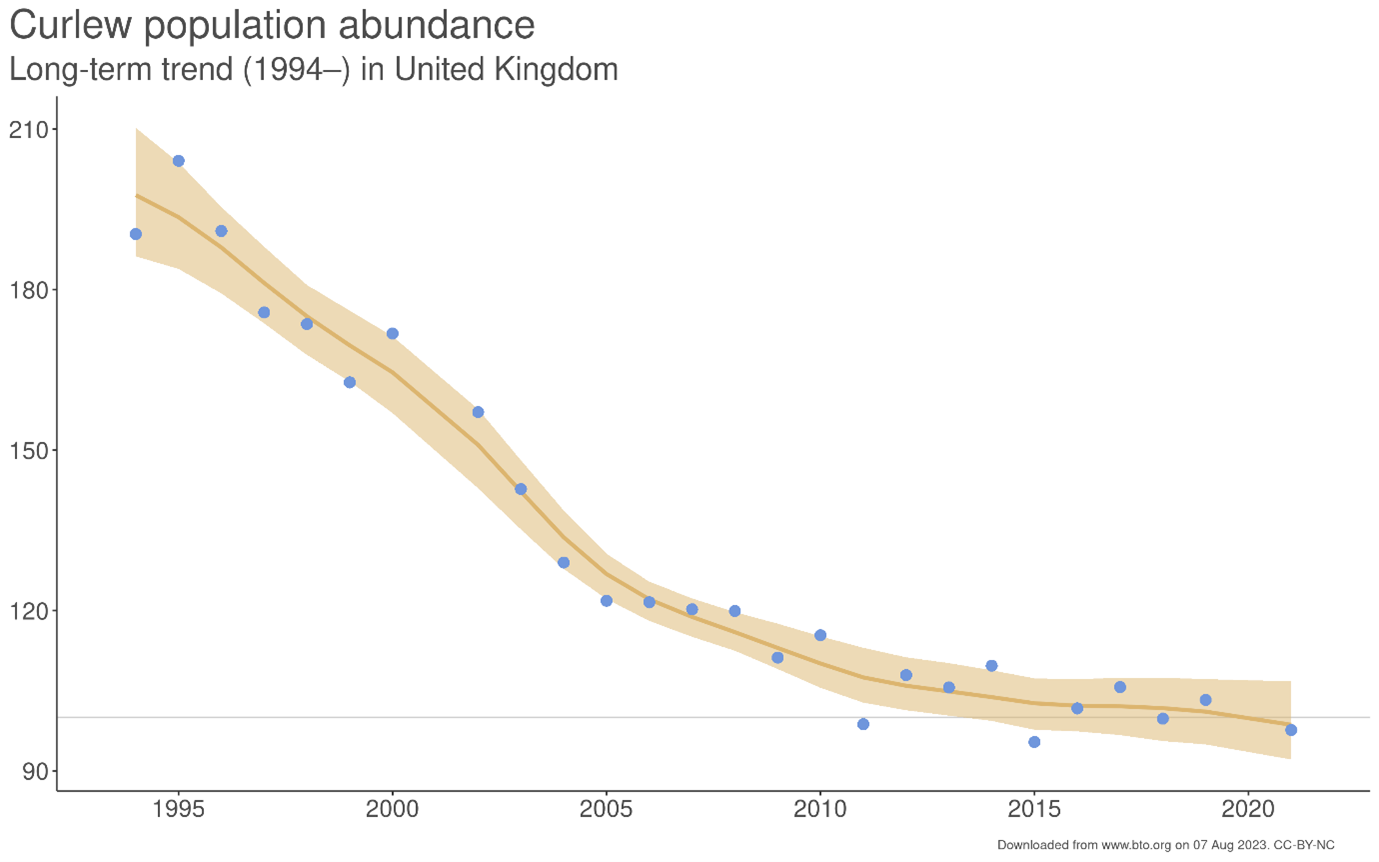
Expand to view full graph
The graph above explained:
Curlew population abundance (as measured by Breeding Bird Survey observations) 1995-2022. The X-axis is years from 1995 to 2022, and the Y-axis is expressed as an ‘index’ of Curlew abundance, set to 100 in the penultimate year. An easy way to interpret this is to say that for every 100 birds present now, the trend line shows how many were present in the previous year. The shaded area shows uncertainty around the trend line (based on 85% confidence limits) and values for individual years are shown as dots.
Changes in land management have driven national declines. European and UK government incentives, technological advancement, and consumer demand have transformed farming over the last century. Societal demands for low-cost food and milk have driven farmers towards ever-increasing levels of intensification, reducing the amount of non-intensive grassland available for Curlew, as well as the time available for breeding Curlew to lay and incubate eggs and then raise their chicks. We have also more than doubled our forest cover in the UK over the last century, with commercial interests, biodiversity conservation, and climate change mitigation all contributing to pressures for continued forest expansion. These changes to our landscape also seem to have favoured populations of generalist predators like fox and Carrion Crow that are predators of Curlew eggs and chicks (at a time when predator control regimes have also shifted radically). Whilst the exact nature of the complex interplay between farming, forestry, and predators is not well understood, it appears that a national shift towards intensive agricultural monocultures interspersed with greater tree cover has benefitted generalist predators, to the detriment of Curlew and other ground-nesting birds.
How you can help – keep a look-out for colour-ringed Curlew
In addition to the birds that have been fitted with GPS tags, there are a number of other colour-ringing projects looking to help track the movements of Curlews. Fully trained and licenced bird ringers have been catching Curlews and fitting a unique combination of colour rings onto their legs, to help with research. These do not harm the bird at all but do allow researchers to identify individual birds and track their movements. We are asking any birdwatchers to look carefully in case any Curlews they see have these colour rings. If you do see one, please make a careful note of the coloured rings and their position on each leg. Please also record the date and location, including an accurate grid reference and send the details to research.sightings@bto.org
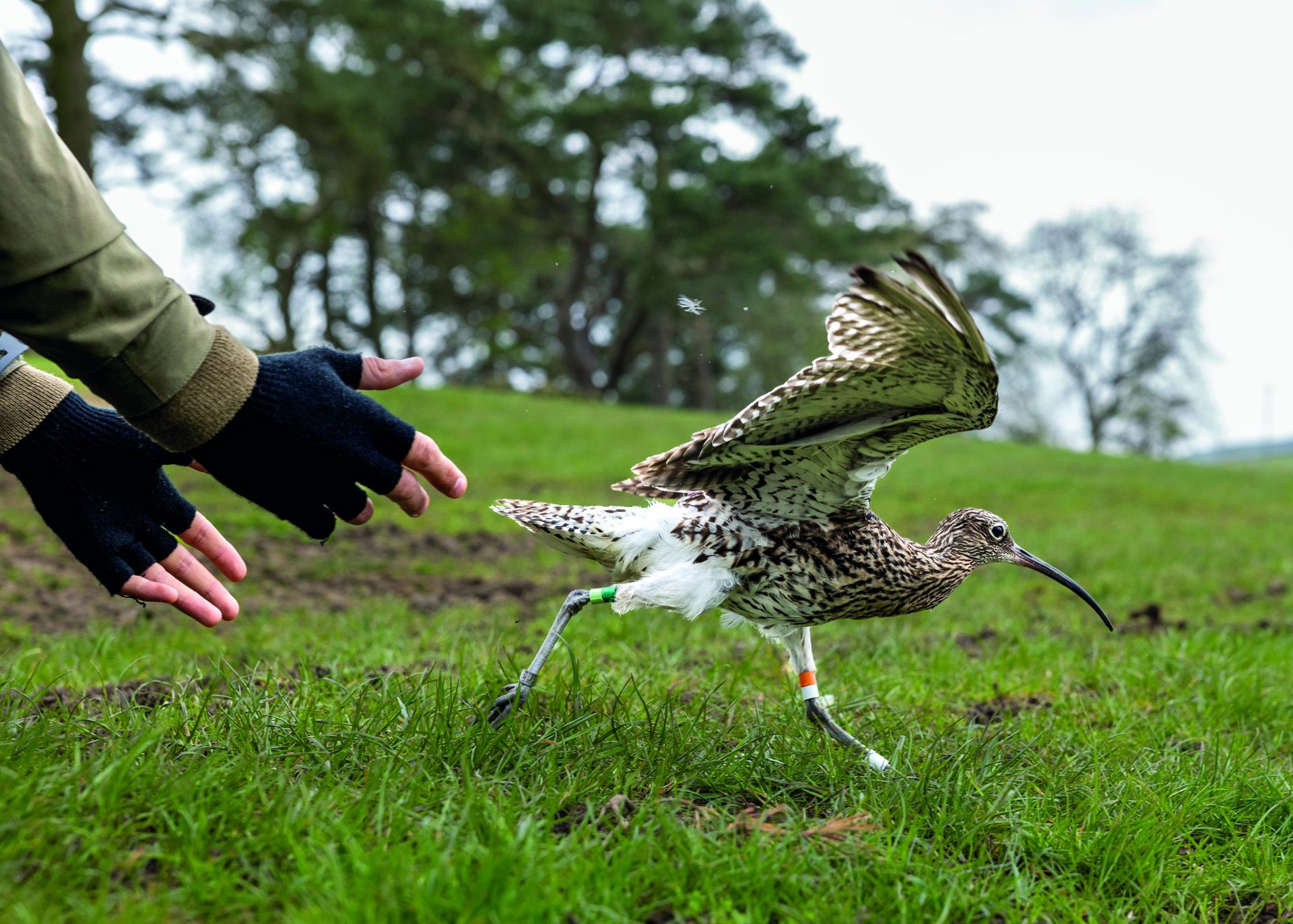
Curlew released after tagging
How we chose the names of our Curlews
The landowner, manager, or local farmer was invited to provide a name for the Curlews. Not all the local stakeholders did, but it was the case for the following birds:
- Alderman
- Cote
- Hunters
- Colin
- Carrot
- Anderson Jack
The names had some either meaningful significance to the relevant stakeholder (e.g. after a person or the place where they were tagged), or were names nominated by their children!
The BTO ecologists gave some of the other names as a fun shorthand, which simply relates to the colours in the individual-identification bit of the colour combination. This was the case for the following birds:
- Bee (NY = black, yellow – bumblebee)
- Xmas (RG = red, green)
- Carlos (RY = red, yellow – Spanish flag)
Others are simply being referred to as their individual colour combinations, such as:
- Green Lime
- Orange Lime
- Lime Orange
- Lime Noir
- Orange White
- Green Orange
- White Lime
Xmas the curlew
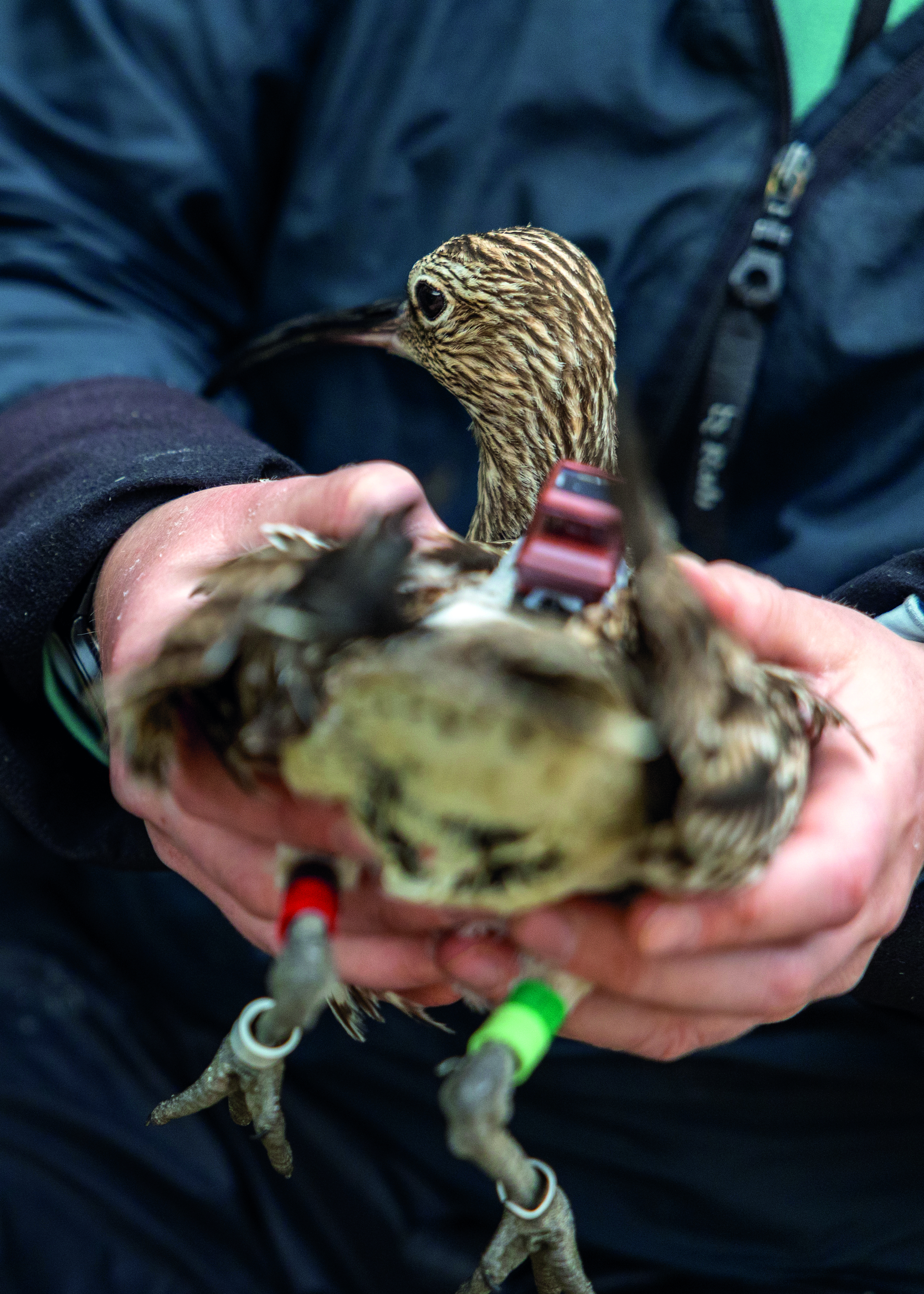
Xmas the curlew
Resources
[1] Birdlife International (2004) Birds in Europe: population estimates, trends and conservation status. Cambridge, UK: BirdLife International. (BirdLife Conservation Series No. 12).
[2]. Franks, S.E., Douglas, D.J.T., Gillings, S., and Pearce-Higgins, J.W. (2017) Environmental correlates of breeding abundance and population change of Eurasian Curlew Numenius arquata in Britain. Bird Study 64(3): 393-409.
[3] Calladine, J., Border, J., O’Connell, P., and Wilson, M. (2022). Modelling important areas for breeding waders as a tool to target conservation and minimise conflicts with land use change. Journal for Nature Conservation 70: 126-127.
[4] Wilson, A.M., Ausden, M. & Milsom, T.P. (2004) Changes in breeding wader populations on lowland wet grasslands in England and Wales: causes and potential solutions. Ibis 146: 32–40.
[5] Wilson, A.M., Vickery, J.A., Brown, A., Langston, R.H.W., Smallshire, D., Wotton, S. & Vanhinsbergh, D. (2005) Changes in the numbers of breeding waders on lowland wet grasslands in England and Wales between 1982 and 2002. Bird Study 52: 55–69. doi: 10.1080/00063650509461374
[6] Sim, I.M.W., Gregory, R.D., Hancock, M.H. & Brown, A.F. (2005) Recent changes in the abundance of British upland breeding birds. Bird Study 52: 261–275.
[7] https://www.forestresearch.gov.uk/tools-and-resources/statistics/forestry-statistics/forestry-statistics-2018/woodland-areas-and-planting/woodland-area-2/area-of-woodland-changes-over-time/
[8] https://publications.parliament.uk/pa/cm5802/cmselect/cmenvfru/356/report.html