Dairymaids in the census record
Tuesday 21 August, 2018
By
Karen Griffiths
Interpretation Officer for the Yorkshire Dales National Park Authority
More from
Karen Griffiths
Census records provide a fascinating snapshot of communities, telling us who lived where and with whom and often what their occupations were. Thanks to the wonderful Dales Genealogy website, we have access online to full sets of censuses for Wensleydale from 1841 through to 1911. They provide us with an interesting picture of the number of women involved in dairy work in Wensleydale over that period of time.
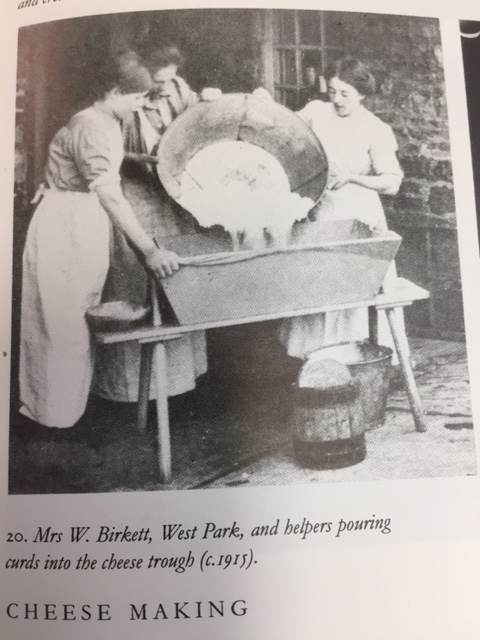
From Marie Hartley & Ella Pontefract’s ‘Life & Tradition in the Yorkshire Dales’
As a starting point we have sampled two villages: Hawes and Carperby and picked out all those households with a woman involved in ‘dairy work’ or listed as a ‘dairymaid’.
The 1841 census only records the occupation of the head of the household so our first set of data comes ten years later with the 1851 census. Carperby has no women listed as being involved in dairying that year, but Hawes parish has five women working as dairymaids.
In Appersett for instance we have the following household recorded:
JACKSON James/Head/M/35/propr, occ. 73ac/Yks/Burtersett
JACKSON Elizabeth/wife/M/32/Yks/Hawes Twp
JACKSON James/son/8/Yks/High Abbotside
JACKSON Thomas/son/4/Yks/Appersett
JACKSON Alexander/son/1/Yks/Appersett
ALLEN Eleanor/serv/21/dairymaid/Yks/High Abbotside
In this instance, James Jackson farms 73 acres from the village with his wife Elizabeth. They have three sons but no daughters so we can assume that because Elizabeth needed help in the dairy they employed 21 year old Eleanor Allen.
In this next example from Midd[le] Mossdale we have an unmarried farmer with a large farm, again, employing a woman as dairymaid:
MOORE James/Head/U/53/farmer 125ac/Yks/Collier Holm
MOORE Alice/serv/U/54/dairymaid/Yks/Collier Holm
MOORE James/15/farm serv/Yks/Cotterdale
METCALFE Susannah/serv/-/house serv/Yks/Hawes
Finally, we find several farms where one or more daughters are listed as being employed as dairymaids such as this one from Hawes village where it seems that all the older children are employed on the family farm. Rose, aged 14 is the dairymaid, no doubt helping her mother who has the same name.
METCALFE Thomas/Head/M/51/farmer 94ac/Yks/Hawes Parish
METCALFE Rose/wife/M/48/Yks/Hawes Parish
METCALFE Richard/son/U/23/carter/Yks/Hawes Parish
METCALFE Thomas/son/U/18/shepherd/Yks/Hawes Parish
METCALFE Rose/dau/U/14/dairymaid/Yks/Hawes Parish
METCALFE Ann/dau/12/scholar/Yks/Hawes Parish
METCALFE James/son/8/scholar/Yks/Hawes Parish
METCALFE Elizabeth/dau/4/scholar/Yks/Hawes Parish
Thus we see three typical scenarios; a family farm where because there is no daughter to help the wife or they are too young, a dairymaid is employed; the family farm where a daughter works as a dairymaid, and finally, the unmarried farmer who employs a woman as his dairymaid. We can assume from our previous research that the farmer’s wife if present would always be in charge of the dairy but that given all her other farm and domestic responsibilities, she would nearly always need help, either from a daughter or a hired servant.
A fourth scenario seems to be where a gentleman farmer employs a dairymaid to do work which would have perhaps been considered below the dignity of a wife or daughter. The 1861 census for Carperby lists one Thomas Willis of the Manor House. He farms 200 acres and has a son and daughter both in their 30s but with no occupations listed. Instead he employs a large number of servants and farmhands including 26-year old Ann Holmes as a dairymaid.
The 1911 census for both parishes introduces us to the occupation of ‘dairy work’ alongside that of ‘dairymaid’. Richard and Mary Moore of Snaizeholme for instance have two daughters: Annis (18) and Agnes (15) who have ‘dairy work’ as their occupation. We wonder if these and at least some of the 23 other women listed with the same occupation in Hawes parish that year are possibly employed in small factories rather than on the farm. We already know that Edward Chapman had established the Wensleydale Dairy in the centre of Hawes by this point in time. Indeed, he and his extended family appear in the same census residing at two properties at ‘The Mill’ in Hawes:
CHAPMAN Edward/husband/62/M/corn miller & dairyman/Yks/Askrigg
CHAPMAN Mary Jane/wife/43/M/10/Dur/Coundon – 3 children, 3 living
CHAPMAN Nellie/dau/9/Yks/Leeds
CHAPMAN Gladys/dau/8/Yks/Leeds
CHAPMAN Ida/dau/7/Yks/Hawes
CALVERT Bertha Stella/serv/18/S/dom serv/ Yks/Middlesboro
Mill
CHAPMAN Nancy Brunskill/head/38/S/dairymaid, Wensleydale Dairy/Yks/Hawes
CHAPMAN Agnes Stuart? /sister/28/S/ housekeeper/ Yks/Hawes
CHAPMAN James/bro/24/S/dairyman, Wensleydale Dairy/ Yks/Hawes
Of course it may be that the terms ‘dairy work’ and ‘dairymaid’ are simply used interchangeably.
The numbers of women employed as dairymaids or dairy workers in these two parishes seems to rise to a small peak in 1871, followed by a fall and then peaks again in 1911.
Carperby – 1851 no dairymaids; 1861 two dairymaids; 1871 three dairymaids; 1881 no dairymaids; 1891 one dairymaid; 1901 no dairymaids; 1911 five dairymaids
Hawes – 1851 one dairymaid; 1861 four dairymaids; 1871 seven dairymaids; 1881 four dairymaids; 1891 one dairymaid; 1901 no dairymaids; 1911 30 dairymaids or dairy workers.
We can speculate that the very large numbers in Hawes in 1911 must represent, at least in part, women employed at the Wensleydale Dairy which opened in 1897 though why there are no dairymaids listed in 1901 in Hawes parish is a mystery. We decided to investigate this further so we looked at Bainbridge parish and found a similar picture of peaks and troughs.
In 1851 there are four women listed as working as ‘dairymaids’ in the parish of Bainbridge. By the next census in 1861 there are a remarkable 18 ‘dairymaids’ listed – including sisters to the head of household, daughters, nieces and granddaughters, along with servants. Ten years pass by and the numbers have plummeted back to just three in 1871. In 1881, there are still only three listed and then there are none until the 1911 census when suddenly 17 women are listed as involved in ‘dairy work’.
Given that many of these women are family members so not ‘sackable’ as such (though eminently marriageable of course), one wonders what lies behind these very local peaks and troughs. It’s clearly a more complex picture than we at first thought. Bainbridge as we know from our previous blog post Harpers Mill and its dairymaids has a small cheese factory in the 1920s but we don’t know exactly when it opened. It’s tempting to think that, as in Hawes, at least some of Bainbridge’s 1911 census dairy workers were employed there but we have no proof as yet.
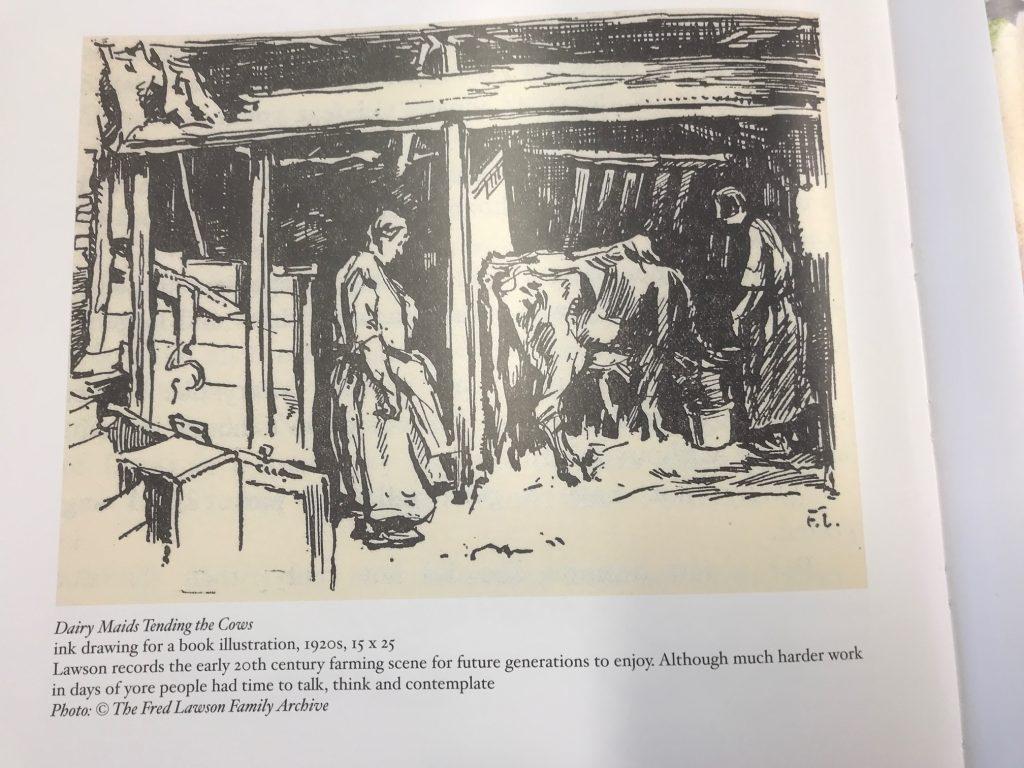
Dairy Maids tending the Cows [Finghall, near Leyburn] by Fred Lawson. 1920s. From John Duncalfe’s book A Painter’s Life