Objective 1.1
Little or no progress
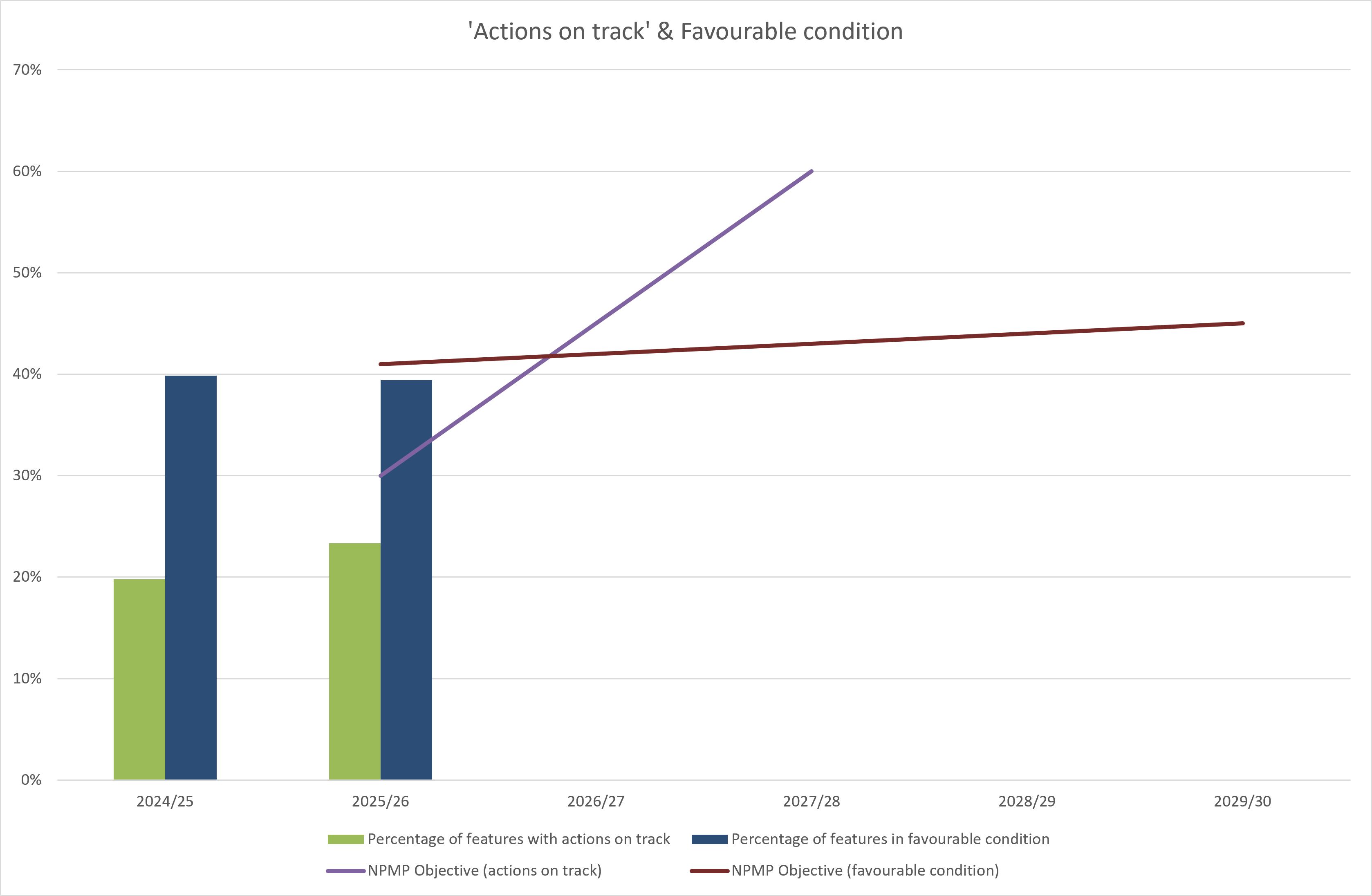
Improve the condition of protected wildlife sites so that 60% of features in Sites of Special Scientific Interest are assessed as having ‘actions on track’ to achieve favourable condition by the start of 2028, and at least 45% are in favourable condition by 2030.
Progress
23% of SSSI’s have ‘Actions on track’. This represents an increase from 20% in 2025 but does not suggest that the objective is likely to be achieved. 39% of features in SSSIs are in ‘favourable condition’, down from 40% a year ago.
Rationale
National target set by Government as part of the Protected Landscapes Targets and Outcomes Framework. Protected sites are areas of land, inland water and the sea that have special legal protection to conserve important habitats and species. The 57,000 ha of protected wildlife sites – Sites of Special Scientific Interest (SSSIs) - in the National Park form the heart of the most coherent network of semi-natural habitats in England. 40% of the features in SSSIs are in favourable condition (Natural England, 2024) but only 16% of SSSI features are currently assessed as having actions on track to achieve or maintain favourable condition. A designated feature is considered to be in favourable condition when it is being adequately conserved and the results from monitoring demonstrate that the feature is meeting all the mandatory monitoring targets set out in the Monitoring Specification for that site. The biggest challenge relates to the 24,000 ha of internationally designated blanket bog, which has become heavily degraded. While initial restoration work has taken place on around half of this peatland, it will still take many years to reach favourable condition again (see objective 2.2).
Lead organisation
Natural England.
Supporting organisations
Yorkshire Peat Partnership; Cumbria Peat Partnership; Yorkshire Dales National Park Authority; National Trust; Cumbria Wildlife Trust; Yorkshire Wildlife Trust.
Cost over 5 years
Funding shortfall